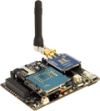
Libelium has officially launched today the Waspmote platform. The research efforts have focused on providing a minimum consumption (0.7uA in the Hibernate mode), and at the same time, maximum performance and capabilities. It comes with three sensor boards which let deploy any kind of aplication using their integrated sensors: CO, CO2, O2, CH4, luminosity, temperature, water level, pressure,...

If you are going to administrate a remote mesh network, the first thing you need to do is setting up an secure mode to access it. The IPsec protocol provides integrity and confidenciality of data transiting the network, although it may be very hard to set up due to the big number of options that can be configured. This article describes how to configure a secured and remote access to a network in an easy way, using Open VPN

In this article we set some of the basics to create an autonomous solar node which lets the mesh network to be created in any place where there are no energy resources.

This article is a brief checklist with the general security instructions for Meshlium using the Meshlium Manager System. Aspects covered are password change, WEP/WPA encryption, hide ESSID, MAC filtering, OLSR secure plugin, encrypting data and backup configuration.

Mesh networks relevant issue is the time synchronizing. Usually having all the nodes with a common time is really important. In order to provide several ways to synchronize Meshlium, Meshlium Manager System offer two ways to get a central time for mesh routers.
This article explains how to configure the Manager to Synchronize Meshlium time with ntp servers or GPS time through NMEA info.

This article introduces the importance of protecting data stored in a mesh router and describes a process for keeping them encrypted using the Meshlium Manager System.

Advantages of using the Second generation of Mesh, where two radios are used to create two different mesh networks. Meshlium radios work in different frequencies to get maximum throughput in the communications.

An overview about configuration and use of the Meshlium Manager System capabilities to send and receive system information of Meshlium within a mesh network. How to send Meshlium System information to a central server, and how a Meshlium receive, manage and store information from other Meshliums acting as a central server.

An overview about configuration and use of the Meshlium Manager System capabilities to send and receive system information of Meshlium within a mesh network. How to send Meshlium system information to mesh brothers, and how a Meshlium receive, manage and store information from other Meshliums.